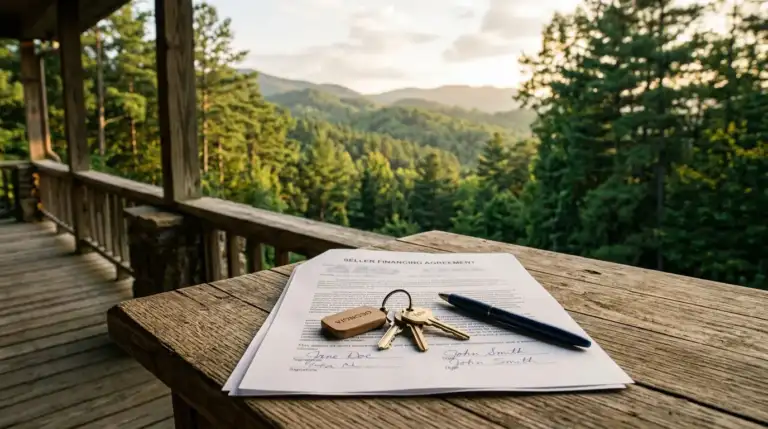

Owner-financed land is land where the seller agrees to accept payments over time instead of requiring a bank loan at closing. It can help a buyer who needs a different path to purchase, but every term is private. Before committing, confirm access, title, utilities, payment terms, and the plan for any balance that comes due later.
Owner-financed land in North Georgia can be a useful option when bank financing does not fit, provided the parcel and the contract both hold up to careful review.
Start With the Parcel, Not the Financing Pitch
North Georgia land can look simple from a listing photo and turn complicated at the property line. A wooded tract near Dahlonega, a ridge parcel in White County, or a rural lot in Dawson County may each have very different access, drainage, survey, utility, and restriction questions. Owner financing does not solve those property questions. It only changes how the buyer and seller arrange payment.
Walk the land if you can. Use the same route you would use after closing, not only the prettiest road to a showing. Ask where the legal access is shown, whether the drive crosses another owner’s land, and what documents support the answer. A private gravel drive can be workable, but the right to use it should be clear in the title work rather than assumed from tire tracks.
Land is not one thing. The acreage, slope, road frontage, water, soils, and recorded restrictions each deserve their own question. A financing arrangement should come after that review, not in place of it.
What Owner Financing Changes for a Land Buyer
In a conventional purchase, a lender has its own underwriting process and closing requirements. With owner financing, the seller and buyer negotiate directly. The documents might still look familiar: a purchase agreement, a promissory note, and security paperwork can all be part of the transaction. The exact structure matters, so have a Georgia real estate attorney explain the documents you would be signing and the consequences of a missed payment.
The buyer’s job is to understand the full obligation, not only the monthly amount. Ask what is due at closing, when payments start, whether the payment can change, where payments are sent, whether prepayment is allowed, and whether a remaining balance becomes due on a stated date. If a term is important, it belongs in the written documents.
A balloon payment is the remaining balance due on a future date. It can be manageable when a buyer has a real refinancing, sale, or payoff plan. It is risky when the plan depends on an assumption that has not been tested.
Questions to Ask Before You Make an Offer
- Confirm ownership and liensOrder title work through the closing professional. A seller should be able to convey the interest they are promising, and the title work can identify liens or recorded items that need attention.
- Read the survey and access documentsAsk for the survey if one is available and compare it with what you see on the ground. If access is by easement, have the closing professional explain its location and scope.
- Check the practical build questionsAsk the county and appropriate providers about the questions that affect your intended use, such as driveway permits, septic review, wells, power, and flood information.
- Put financing terms in plain languageAsk for the payment schedule, default terms, insurance and tax responsibilities, and any final payoff date in a form you can take to an attorney before signing.
Compare the Paths Before You Decide
| Question | Bank-financed land purchase | Owner-financed land purchase |
|---|---|---|
| Who sets approval requirements? | The lender and its underwriting rules | The seller, through the negotiated contract |
| Who sets the payment terms? | The loan program and lender documents | Buyer and seller, subject to their written agreement |
| What needs close review? | The loan terms and the parcel | The contract terms and the parcel |
| What cannot be assumed? | That every parcel qualifies for a loan | That flexible terms make the parcel suitable |
The comparison is not a scorecard. One route may fit a particular buyer better than the other. The common denominator is due diligence: understand the land, understand the terms, and get independent advice before money changes hands.
Where Buyers Commonly Look in North Georgia
Buyer searches often start around Dahlonega and extend through Lumpkin, White, and Dawson counties because those areas offer a mix of wooded acreage, mountain terrain, and rural roads. Search terms should stay specific: use “owner financing available” and the county or area you actually want, then ask whether the listing is current and whether the seller will provide written terms for review.
For background on the broader search, see our guide to owner-financed land in Georgia. If your search expands beyond land, our overview of owner-financed homes in the North Georgia mountains explains the same buyer-first approach. A parcel described as unrestricted still calls for careful document review; our guide to unrestricted land with owner financing covers the questions worth asking.
Red Flags That Deserve a Pause
Slow down if the seller will not provide written terms, discourages title work, will not identify the access route, or pressures you to send money before an attorney or closing professional can review the deal. Those are reasons to get independent advice, not reasons to rush.
Be cautious with broad promises such as “no credit check” or “instant approval.” A buyer can have a legitimate reason to seek owner financing, but a responsible transaction still requires clear documents, a realistic payment plan, and honest answers about the land. Never treat an informal text-message agreement as a substitute for closing documents.
Build a Buyer-Side Plan for the Final Payment
Some owner-financed arrangements end with a remaining balance due later. Before you sign, sketch the path you expect to use: refinance after improving your financial profile, sell another asset, save toward payoff, or choose a shorter-term purchase you can complete without relying on a future lender. Then test that plan against time, income, and the property itself.
It is fine to decide that a proposal does not work for you. The most valuable outcome of due diligence can be walking away before a difficult agreement becomes your problem. Keep copies of every version of the terms, note who answered each question, and ask your attorney to flag any language you do not understand.
Keep Your File Organized From the First Conversation
Save the listing, every proposed term sheet, survey, county correspondence, title documents, and notes from calls in one place. A clean file makes it easier to compare versions, spot missing answers, and give an attorney or closing professional the context they need. It also reduces the temptation to rely on memory when the details matter.
Frequently Asked Questions
Can I buy land in North Georgia with owner financing?
Sometimes. Availability depends on a seller offering it and on the specific parcel. Treat it as a negotiated purchase, not a standard loan product.
Do I need a survey for owner-financed land?
Ask your closing professional and attorney. A survey can help you understand boundaries, access, and visible features before you commit.
What should I check first on a rural parcel?
Start with legal access, title, the survey, and the practical questions tied to your intended use. Financing should not distract from the land itself.
Can owner financing help if I am self-employed?
A seller may use different approval standards than a bank, but the terms are private. Be ready to show that you can meet the agreed payment obligation.
Who prepares an owner-financing contract in Georgia?
Use a Georgia real estate attorney and a qualified closing professional. This article is buyer education, not legal or tax advice.
What is a balloon payment on land?
It is the remaining balance due on a stated future date. Understand its amount, date, and your realistic plan for meeting it before signing.
Does owner financing include utilities and septic approval?
No. Those are parcel questions. Ask the county and the appropriate providers what applies to the land you are considering.
Can I make a deposit before reviewing the paperwork?
Discuss deposit terms with your attorney or closing professional first. Know when it is refundable, who holds it, and what conditions apply.
What does unrestricted land mean?
It is a marketing term that still requires document review. Ask about recorded covenants, local rules, easements, and any limits that affect your intended use.
Where can I get help finding North Georgia property?
A local real estate professional can help you identify current opportunities and coordinate questions with the right closing and legal professionals.
Looking for a North Georgia property to explore?
Talk with a local real estate team about current homes and land opportunities, then bring your buyer-side questions to the right professionals.
North Georgia mountain homes at Gold Peach Realtyor call (770) 283-1223