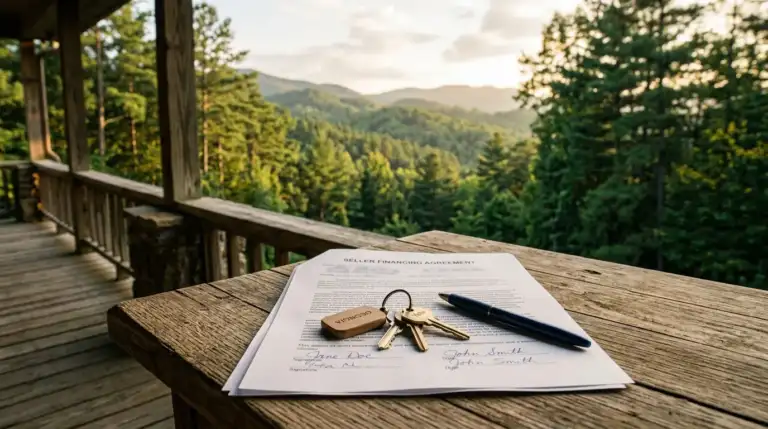

Owner financing means the seller acts as the lender: you sign a promissory note and security deed instead of getting a bank mortgage, then pay the seller directly each month. It can open a door for buyers who do not fit a bank’s box, but the terms are private and vary widely, so read every document before you sign.
Buying a home in the North Georgia mountains without a bank is more common than most people think.

What Owner Financing Actually Means in Georgia
When you buy a home the usual way, a bank hands the seller cash and you repay the bank. Owner financing removes the bank from the middle and lets you pay the seller over time. To understand the process, review Owner Financing Georgia: How It Works for Buyers and Sellers .
In Georgia, this arrangement is normally documented with a promissory note (covering the amount, interest rate, and payment schedule) and a security deed (which lets the seller reclaim the property if you stop paying). It shows up most often on owner-financed homes and on rural land around Dahlonega, Lumpkin, Hall, White, and Dawson counties. For broader context, explore our Owner Financing in Georgia: A Complete Buyer’s and Seller’s Guide .
You gain flexibility a bank rarely offers. In exchange, you give up the standardized paperwork and consumer protections of a conventional mortgage. Treat every deal as its own negotiation.
How the Money and Paperwork Flow
Owner financing follows a structured path from initial agreement to final payoff:
- Agree on price and terms: Purchase price, down payment, interest rate, monthly payment, and how long until the balance is due are set directly with the seller. Learn more about How to Structure an Owner-Financed Deal in Georgia: Down Payments, Terms, and Legality .
- Put money down: Down payments are commonly larger than a low-down bank loan. How much you put down is one of the first things a seller will discuss.
- Sign the note and security deed: These key legal documents should ideally be prepared or reviewed by a Georgia real estate attorney before you commit.
- Take possession and pay monthly: Payments continue according to schedule, often with a final balloon payment or a refinance target a few years out.
A balloon is a lump sum for the remaining balance that comes due on a set date, common in owner financing. Before you sign, make sure you have a realistic plan to refinance, sell, or pay it off by then.
Owner Financing vs. a Conventional Mortgage
| Feature | Bank mortgage | Owner financing |
|---|---|---|
| Who lends | A bank or mortgage company | The home seller |
| Approval | Credit score, income docs, underwriting | Whatever the seller accepts |
| Down payment | Often lower, program-dependent | Commonly larger; fully negotiable |
| Interest rate | Set by the market | Set by the seller; often higher |
| Loan length | Usually 15 to 30 years | Often shorter, frequently with a balloon |
| Paperwork | Standardized, heavily regulated | Private contract, read every line |
Who Owner Financing Tends to Fit
Owner financing is a practical solution for several types of North Georgia real estate buyers:
- Self-employed and 1099 earners whose income is real but hard to document the bank’s way. Read why Owner Financing for Self-Employed Buyers in Georgia works effectively.
- Buyers rebuilding credit who can afford payments but will not clear an automated bank approval yet.
- Land and cabin buyers in the mountains, where some rural parcels are hard to finance conventionally. Check out our Dahlonega Owner Financing: A Buyer’s Guide to Mountain Property .
- Relocators who want to move now and refinance into a bank loan later.
Be wary of any pitch that leans on “no credit check” or “instant approval” as if those were features rather than warning signs. A fair owner-financed deal survives an attorney reading it.
The Risks a Careful Buyer Checks First
Before moving forward, protect your investment by evaluating these critical questions:
- Does the seller own the home free and clear? If they still owe a bank, their loan may have a due-on-sale clause. Order a title search to verify.
- Who pays taxes and insurance going forward? Spell out responsibility for property taxes and home insurance explicitly in writing.
- What happens if you miss a payment? Georgia’s legal process can move quickly, so understand the cure period and default terms before you sign.
- Is there a balloon you can realistically meet? A manageable monthly payment with an impossible balloon deadline is not a sustainable deal.
This is buyer-level education, not legal or tax advice. For statutes and your specific figures, talk to a Georgia real estate attorney and a tax professional.
How to Find Legitimately Owner-Financed Homes in North Georgia
Owner-financed listings are less advertised, so finding them takes legwork. Watch for listings that mention “owner financing available,” ask agents who work rural and land inventory, and explore Owner Financed Land in Georgia: Mountains, Farms, and Rural Properties . When you find a candidate, verify ownership, read the note, and confirm how to structure the terms before you commit.
Frequently Asked Questions
Is owner financing legal in Georgia?
Yes, when documented properly with a promissory note and security deed. Have a Georgia real estate attorney prepare or review the documents.
Do I need good credit for owner financing?
Not necessarily. The seller decides what they accept, so credit-challenged and self-employed buyers often qualify where a bank would decline.
How much down payment do owner-financed homes require?
It is negotiable and commonly larger than a low-down bank loan. Ranges vary widely, so ask early and get the number in writing.
Who holds the deed in an owner-financed sale?
In a typical Georgia structure you take title and the seller holds a security deed that lets them reclaim the property if you default.
Is the interest rate higher with owner financing?
Often yes, because the seller takes on the risk a bank normally would. Weigh the rate against the flexibility you gain.
Can I refinance an owner-financed home later?
Many buyers plan to: buy now, build credit and payment history, then refinance into a conventional loan before a balloon comes due. Confirm there is no prepayment penalty.
What happens if I miss a payment?
That depends on your contract and Georgia law, and it can move faster than buyers expect. Understand the default and cure terms in writing before you sign.
Does owner financing work for land and cabins in the mountains?
Yes, and it is especially common for rural parcels around Dahlonega that can be hard to finance conventionally.
Should a lawyer review an owner-financing contract?
Yes. A Georgia real estate attorney reviewing the note and security deed is the best protection a buyer has.
How do I find owner-financed homes for sale in Georgia?
Look for listings noting owner financing available, ask agents who handle rural and land inventory, then verify ownership and terms before committing.
Ready to find owner-financed properties in North Georgia?
Work with a local expert who knows the mountains and the deals that never hit the big portals.
Search North Georgia homes with Gold Peach Realtyor call (770) 283-1223