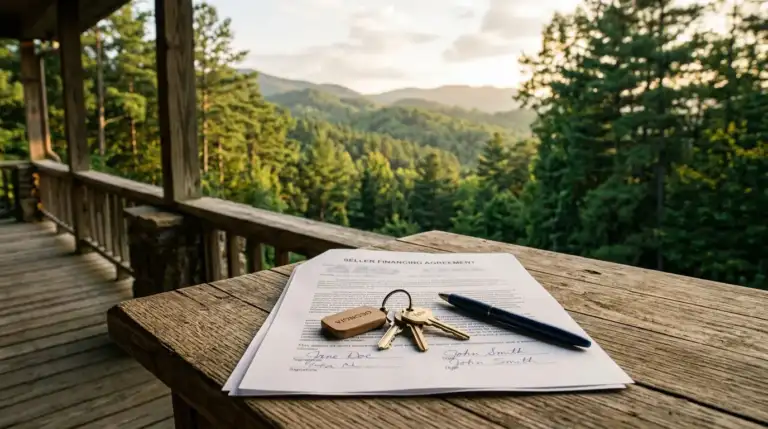

In North Georgia land marketing, unrestricted usually means the parcel may have fewer private use limits than property governed by recorded covenants. It does not guarantee that every use is allowed. Buyers still need to verify the deed, plats, access, county rules, septic feasibility, utilities, flood exposure, and the owner-financing documents.
Treat unrestricted as a prompt for due diligence, not a legal conclusion. Recorded documents, county rules, site conditions, and the signed financing agreement decide what a buyer can do.
A parcel can look wonderfully simple in an advertisement: open ground, trees, a road nearby, and a seller willing to finance the purchase. The word unrestricted often makes the property sound ready for almost any plan. That is where a careful buyer slows down. The word is useful as a search term, but it is not the same thing as a complete land-use review.
What does ‘unrestricted land’ usually mean?
In ordinary land advertising, the label often points to an absence of known private covenants that tightly control home size, exterior appearance, animals, outbuildings, or similar uses. That can make a parcel appealing to buyers who want a workshop, garden, small farm, cabin, or recreational base. The label still needs proof. A seller’s description may be incomplete, and records may contain restrictions or easements that are not obvious during a drive-by visit.
Public rules are separate. County zoning, building and driveway requirements, environmental health standards, floodplain limits, utility availability, and state or federal rules can apply even when no private covenant appears in the title search. The practical question is not simply whether the parcel is called unrestricted. It is whether your intended use works on this parcel under its recorded rights, physical conditions, and applicable public rules.
| What you may hear | What it does not prove | What to verify |
|---|---|---|
| “No restrictions” | That no deed covenant or easement affects the parcel | Title work, deed, plats, and recorded instruments |
| “Build anything” | That the site supports the proposed structure or use | County planning, permits, setbacks, access, and site review |
| “Ready for septic” | That a suitable system can be approved | Environmental health review and site-specific evaluation |
| “Easy owner financing” | That the payment and title documents protect the buyer | Written terms, title examination, closing documents, and professional review |
Unrestricted does not mean unregulated. A buyer should match one specific intended use to the parcel, then confirm that use through recorded documents, county offices, utility providers, and site professionals. A broad verbal assurance is much weaker than a written answer tied to the exact parcel number and proposed plan.
Ask the seller or listing representative what unrestricted means for this parcel, then verify the answer independently. Put important assumptions into the purchase agreement as appropriate after a Georgia real estate attorney has reviewed the language.
The records and site conditions to check
Start with the deed, title work, and recorded plats
The deed identifies the legal parcel and may refer to earlier instruments. A title examination can reveal easements, access rights, liens, and recorded covenants. Plats can show boundaries, roads, utility corridors, and other features that affect where improvements might fit. Georgia’s statewide clerk records portal, local clerk records, and a closing attorney are useful parts of this review. A tax map is helpful for orientation, but it is not a substitute for a current survey.
Confirm legal and practical access
Road frontage in a map view does not automatically answer whether a buyer has legal access or whether a driveway can be approved. A shared or private road may depend on a recorded easement and a maintenance agreement. Steep grades, creek crossings, culverts, and sight-distance concerns can also change the cost and feasibility of reaching a building area. Walk the likely route with the right local professionals instead of assuming a visible trail is sufficient.
Check soils, water, drainage, and utilities
Rural land may rely on a well and an onsite wastewater system. Soil maps are a useful screening tool, but they do not replace a parcel-specific evaluation. Buyers should also review flood maps, surface drainage, stream buffers, and signs of wet ground. Then confirm power, internet, and other services directly with providers. A utility line seen nearby does not prove that connection is available on acceptable terms.
How owner financing changes the purchase review
Owner financing changes who extends credit. It does not cure a land defect, create access, approve a septic system, or settle a boundary. Buyers should evaluate the parcel and the financing as two connected parts of one decision. The land must work for the intended use, and the documents must state what is owed, when it is owed, what secures the obligation, and what happens if either side does not perform.
For a broader foundation, read how owner financing works in Georgia. Buyers comparing structures may also want the site’s owner financing and rent-to-own comparison. The two arrangements can create very different questions about title, possession, payments, and the path to ownership.
A flexible seller may agree to a due-diligence period, survey review, or other written conditions. Those points belong in the actual agreement, not in a text message or an informal promise. Use a Georgia real estate attorney and qualified tax or lending professionals for advice on the specific deal.
Terms a buyer should understand before signing
The written deal should make the purchase price, money due at closing, payment method, interest calculation, maturity date, balloon terms, late or default provisions, taxes, insurance, closing costs, and recording plan understandable. It should also identify the deed and security documents the closing attorney will use. This article is buyer education, not legal, financial, or tax advice.
A practical way to compare unrestricted parcels
Comparison gets easier when every parcel is judged against the same intended use. Write down what you actually want to do, such as build a primary home, keep animals, add a workshop, or hold the land for recreation. Then collect the same categories of proof for each candidate. This prevents a good view or an attractive payment proposal from hiding an access or buildability problem.
| Review area | Questions for the buyer file | Useful proof |
|---|---|---|
| Intended use | What exactly do you plan to build, keep, or operate? | Written use description and county feedback |
| Title and access | Are the boundaries and access rights clear? | Title work, deed, plats, easements, and survey |
| Site feasibility | Where could access, water, wastewater, and improvements go? | Site visits, environmental health input, maps, and contractor review |
| Owner financing | Can you explain every payment and default term in plain language? | Term sheet, attorney-reviewed contract, note, and security instrument |
The site’s guide to owner-financed land in Georgia adds more buyer-side context for evaluating rural property. Use it as a planning guide, then verify each parcel independently. No article can confirm a parcel’s restrictions, access, soils, utilities, or financing terms without the actual records and documents.
Questions to ask before making an offer
Ask for the parcel number, current deed, available survey or plat, and any title or covenant documents the seller has. Ask whether access is public or private, whether a maintenance agreement exists, and which county office has reviewed the proposed use. Request written owner-financing terms early enough to compare the total obligation with the land’s condition and your exit plan.
Visit the property in conditions that reveal drainage and access when practical. Mark the likely driveway, building area, well area, and wastewater area with professionals who can evaluate them. If a proposed use is central to the purchase, ask your attorney how to address that assumption in the agreement. A clean due-diligence file is more useful than a collection of verbal assurances.
Frequently Asked Questions
Does unrestricted land mean I can build anything I want?
No. The label may suggest fewer private covenants, but county rules, permits, setbacks, access, environmental health requirements, easements, and site conditions can still limit a plan. Verify the exact intended use with records and the responsible offices before relying on the description.
Can owner financing make an unbuildable parcel buildable?
No. Financing changes the payment relationship between buyer and seller. It does not create legal access, suitable soils, utilities, permits, or a usable building area. Complete the land review separately from the financing review.
How do I verify whether land really has no private restrictions?
Review the current deed, referenced instruments, title work, plats, and any recorded covenants. A Georgia closing attorney can examine the record for the specific parcel. Do not rely only on a tax map, advertisement, or seller statement.
Is a survey necessary for unrestricted land?
A current survey can help identify boundaries, encroachments, access, and recorded features that a listing photo or tax map cannot settle. Whether one is required depends on the transaction, but buyers should discuss the need with their attorney and other professionals.
What should I check about a private road?
Confirm the recorded access right, road location, maintenance responsibility, condition, and whether the route can support the intended construction and regular use. A visible road or trail is not proof of a permanent legal right to use it.
Does unrestricted land automatically allow a mobile home or RV?
No. Ask the county about the exact proposed use and duration, then review deed restrictions and site requirements. Rules can differ by parcel and jurisdiction, and utility or wastewater needs may create separate limits.
Can I keep animals on unrestricted land?
Possibly, but the answer depends on public rules, recorded restrictions, acreage layout, water, fencing, waste management, and the type and number of animals. Describe the intended use specifically when asking officials or professionals for guidance.
How do I check whether a septic system may work?
Contact the county environmental health office and arrange the site-specific evaluation it requires. Online soil information can help with early screening, but it does not approve a wastewater system for a particular building plan.
Should I check flood maps for mountain land?
Yes. Review current flood mapping and the parcel’s drainage, streams, low areas, and access route. A mapped result is one part of due diligence, not a substitute for walking the site and obtaining professional input where conditions warrant it.
What owner-financing terms matter most for a land buyer?
Understand the price, cash due at closing, payment calculation, interest method, maturity and balloon terms, taxes, insurance, default language, deed and security documents, closing costs, and recording plan. Have the final documents reviewed for your specific transaction.
Can I refinance owner-financed land later?
That may be possible, but a buyer should not assume future approval. Before signing, discuss the likely exit plan with qualified lenders and review timing, property condition, title, improvements, credit, income documentation, and any balloon date in the proposed agreement.
Who should help me review unrestricted owner-financed land?
The team may include a Georgia real estate attorney, surveyor, county planning staff, environmental health staff, title professionals, contractors, utility providers, and qualified tax or lending advisers. The right mix depends on the parcel and intended use.
Looking for North Georgia land with clear next steps?
Gold Peach Realty can help you search current North Georgia property options and organize the questions to take to your attorney, county offices, and land professionals.
Work with a local North Georgia REALTOR at Gold Peach RealtyCall (770) 283-1223.